Related Games
-
 LevelDevil 2
-
 99 in the Forest Playground
-
 99 Nights in the Forest 101% Original
-
 Escape from 99 Nights in the Forest: Obby
-
 Deer Cannibal: 99 Nights in the Forest
-
 Survive 99 Nights in the Forest in Mine!
-
 99 Nights in the Forest: Clicker Weapon Evolution
-
 99 Nights in the Forest. Horror Multiplayer
-
 99 Nights in the Forest - Find All the Kids!
-
 99 Nights in the Forest: Monster Evolution
-
 99 Nights in the Forest with Emma
-
 Scary Chats: Horror Messenger
-
 99 Nights In The Woods: Horror Story Original
-
 99 Nights in the Forest! Nubiki
-
 Call 99 Nights in the Forest
-
 99 Nights in the Forest - Skinwalker Deer
-
 99 Nights in the Forest with Noob and Pro!
-
 99 Nights In The Forest That's Not My Neighbor
About 99 Nights In The Forest That's Not My Neighbor
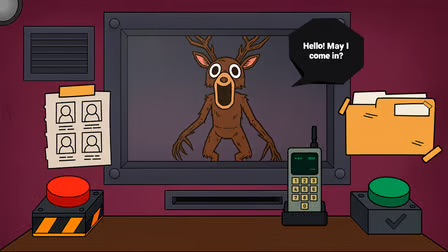
99 Nights In The Forest That's Not My Neighbor spins the saga into a deduction game. You're the gatekeeper of a forest lodge, checking in deer, owls, cultists, kids, goats, and even aliens while impostors try to sneak through.
Spotting subtle differences in paperwork or appearance becomes strangely thrilling when you know Skinwalker might be impersonating a guest.
How to Play
Start each shift by reviewing the guest list and learning who should arrive. Compare IDs, stamps, and portraits with the person standing at your counter.
When something feels off—maybe the horns are shorter or a signature is wrong—detain the visitor. Nights escalate, so accuracy matters more than speed.
Controls
- Mouse: Navigate paperwork, inspect visitors, and make choices.
Tips & Tricks
- Develop a routine: list check, papers, face, dialogue. Muscle memory avoids mistakes.
- Use notes to remember frequent impostor tells like cloak colors or alien accessories.
- Stay calm during rushes—panic approvals are exactly what the fakes want.
About 99 Nights In The Forest That's Not My Neighbor
What Is 99 Nights In The Forest That's Not My Neighbor?
Drawing inspiration from the Papers, Please genre, That's Not My Neighbor transforms you into a forest lodge gatekeeper responsible for screening visitors against guest lists. Your job sounds simple: check credentials and admit legitimate guests while detaining impostors. The complication? Those impostors might be Skinwalker or other monsters assuming the forms of expected visitors.
This deduction game tests observation skills rather than reflexes. You'll scrutinize paperwork, compare photographs to faces, verify signatures, and check for subtle inconsistencies that reveal disguised monsters. The tension builds differently than in action-focused 99 Nights games—here, danger comes from a wrong decision rather than a failed escape.
Visitor Processing
Each shift begins with reviewing the expected guest list. Deer, owls, cultists, children, goats, and even aliens might appear on your manifest, and you must learn to recognize legitimate versions of each. When a visitor approaches your counter, systematic verification prevents mistakes: check their ID, compare their stamp, examine their portrait against the person standing before you.
Impostors make errors that observant gatekeepers catch. Maybe the horns are slightly different shapes, perhaps a signature doesn't quite match, or possibly the visitor claims credentials that contradict the paperwork. Spotting these inconsistencies and making the call to detain rather than admit requires confidence in your observations.
Escalating Challenge
Night shifts escalate in difficulty as the game progresses. More visitors arrive, time pressure increases, and impostors become more sophisticated in their disguises. Accuracy matters more than speed—panic approvals that let monsters through are exactly what the disguised threats want.
Developing systematic verification routines helps manage the pressure. A consistent process—list check, papers verification, face comparison, dialogue analysis—builds muscle memory that prevents mistakes even during rushes. Taking notes about common impostor tells like specific cloak colors or telltale accessories provides quick reference during difficult moments. The satisfaction of catching a clever impostor through careful observation creates memorable moments. Equally memorable are the failures—letting through a monster because you rushed or overlooked an obvious clue teaches lessons that improve future performance.
Comments (0)
Share tips, ideas, and feedback with players.